M&M’S can look identical in a supermarket aisle while carrying different ingredient lists in Britain, the United States and the Gulf. The current UK question is not simply about gelatine. Mars’s own FAQ says the sweets are not halal-certified, and current UK retail panels list carmine in the red-colour system. A Dubai pack follows a different market assurance route.
Quick answer: UK and EU-style M&M’S are MUSHBOOH under HalalLens’s verification rule: Mars says they are not halal-certified, current UK Choco, Peanut and Crispy labels list carmine, and no gelatine is declared. US M&M’S use synthetic colours but remain uncertified. Dubai Municipality says Mars products in Dubai comply with halal-market regulations; check the local pack and mark.
What’s in the shell?
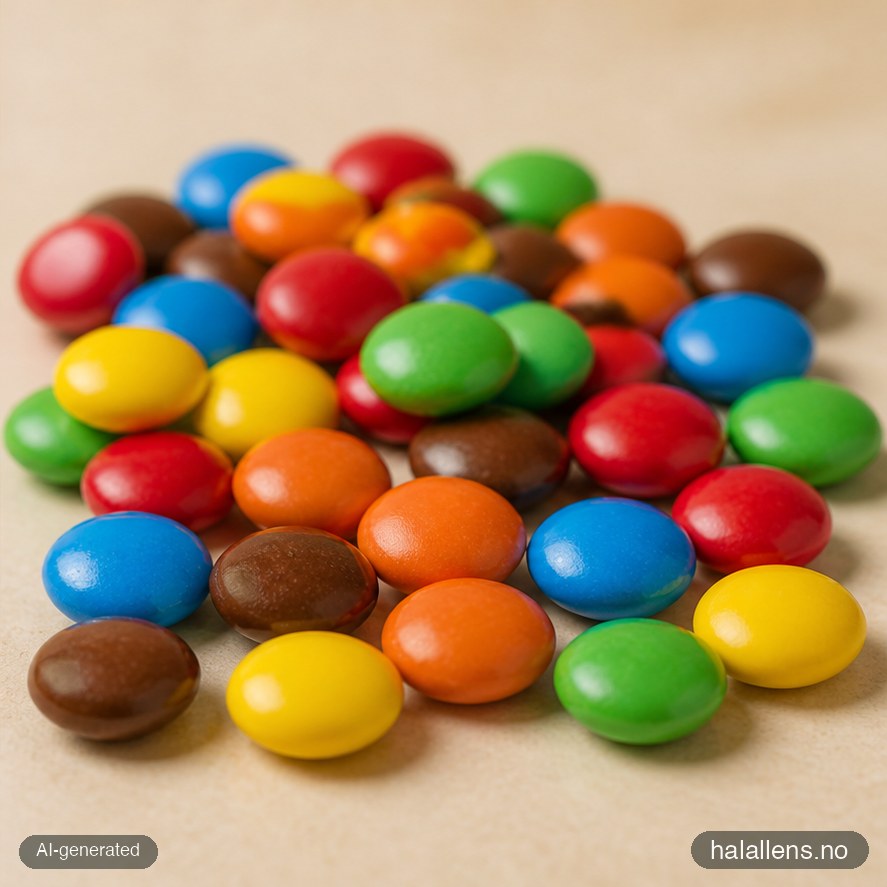
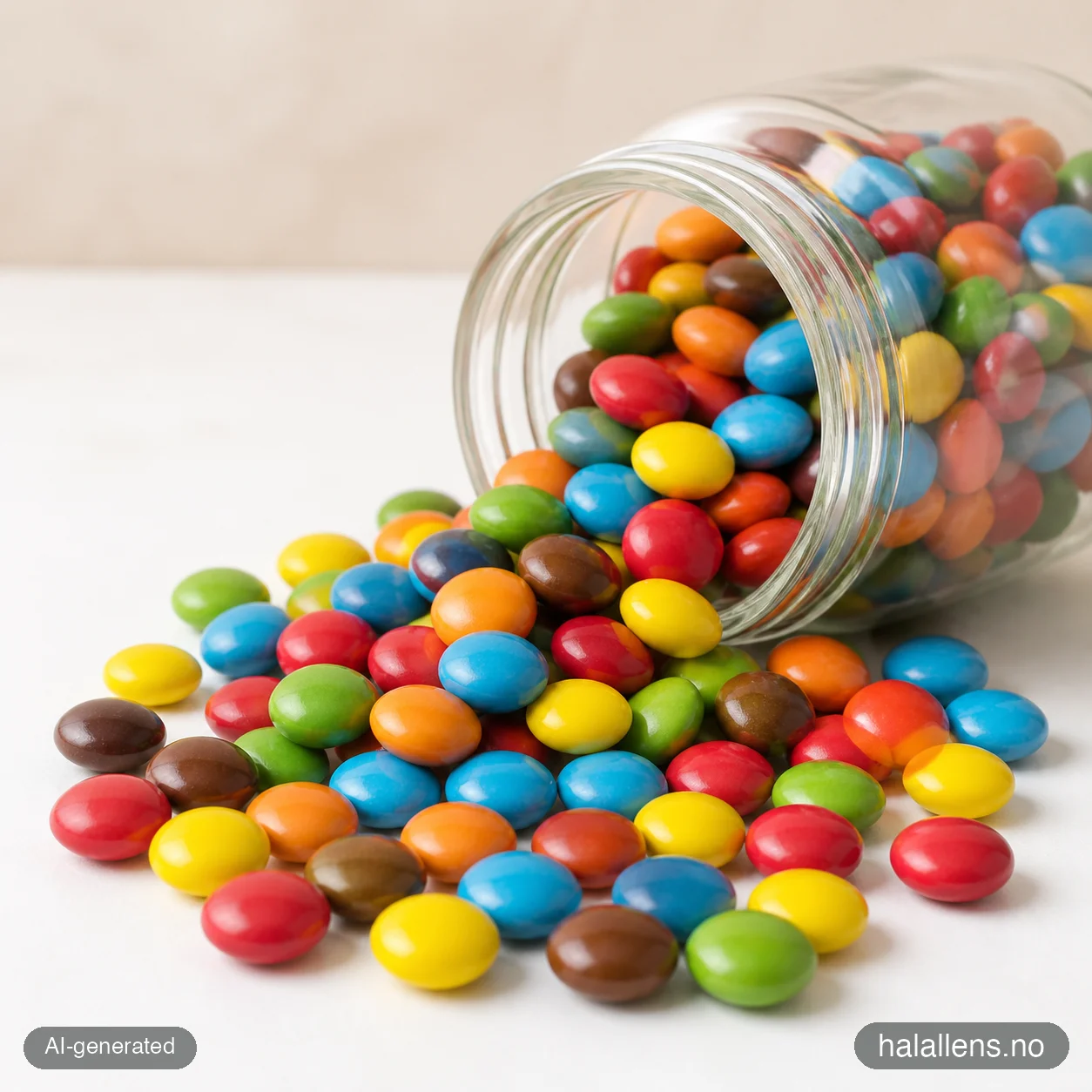
The current UK Choco ingredient panel checked through Tesco describes milk chocolate in a sugar shell. It lists sugar, cocoa mass, skimmed milk powder, cocoa butter, starch, whey permeate from milk, milk fat, palm fat, glucose syrup, shea fat, gum arabic, dextrin, soya lecithin, colours, carnauba wax, salt, palm kernel oil and flavouring. Peanut M&M’S use a closely related shell around a peanut, while Crispy M&M’S add a rice centre and barley malt extract.
The current UK panels do not list gelatine. They do list carnauba wax as the glazing agent. That distinction matters because online discussions often call every shiny candy coating “shellac”, but a current UK label must be read for the actual named glaze. If an imported pack lists shellac or E904, HalalLens classifies that ingredient MUSHBOOH and the pack needs a product-specific decision.
The chocolate centre
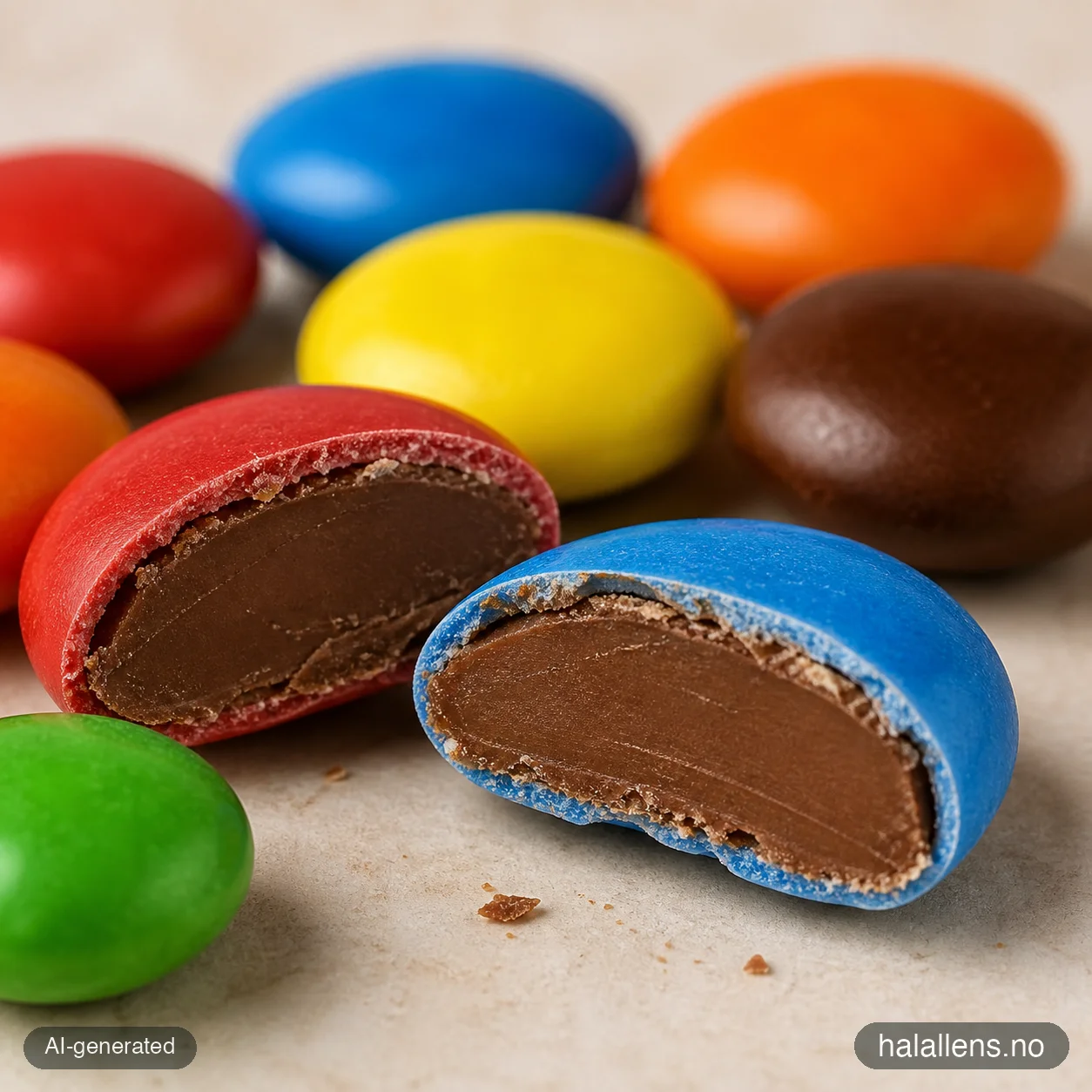
Under the shell, the core product is milk chocolate. The UK declaration names cocoa ingredients, milk powder, cocoa butter, lactose or milk fat, and soya lecithin. These ingredients explain the milk and soya allergen warnings, but they do not by themselves create a halal problem. The panel is still not a certificate, and “vegetarian” does not answer every halal sourcing question.
Crispy uses a different centre. Current retailer information lists rice flour, whey permeate, barley malt extract, dextrose and the same broad shell system. Barley malt is a cereal ingredient, not an alcoholic drink. The presence of barley malt does not make Crispy haram; the live concerns are the colour declaration, certification status and any change in the exact imported recipe.
Mars’s current UK FAQ says M&M’S contain no pork-based ingredients. It does not say that every colour, glaze or production route is halal-certified. For a shopper who accepts ingredient-based assessment, a pack without a prohibited ingredient may be treated differently from a shopper who requires third-party certification. This article keeps those questions separate.
The shellac question: E904 versus carnauba wax
Shellac is a resinous glazing substance associated with lac insects. Its EU additive number is E904, and HalalLens treats it as MUSHBOOH because shoppers may require confirmation of its source and processing. The ingredient page for shellac explains that concern, while E904 is the label term to watch for on imported products.
The current UK Choco, Peanut and Crispy panels checked for this article say carnauba wax, not shellac or E904. Current US Mars product information also lists carnauba wax. That means the shellac rumour should not be substituted for the label. A product can be MUSHBOOH because of certification or carmine even when it contains no shellac, and an imported recipe can change the answer if its named glazing agent changes.
Mars’s position on halal status
Mars’s current UK M&M’S FAQ answers the combined halal, kosher and vegetarian question directly: M&M’S are not certified as halal or kosher, they do not contain pork-based ingredients, and they are generally suitable for vegetarians. The same answer adds that red M&M’S contain a non-vegetarian colouring. This is the manufacturer’s current public position for the market page reviewed.
That wording also corrects two common shortcuts. “No pork” is not the same as halal certification, and “vegetarian” does not settle the status of insect-derived colourants for every Muslim shopper. Current UK Tesco and Ocado panels name carmine in Choco, Peanut and Crispy products, so the red-colour point is reflected in retail ingredient data rather than being an old internet rumour only.
UK/EU, Middle East and US differences
In the UK and the EU-style supply chain represented by the current UK labels checked here, Choco, Peanut and Crispy products list carmine or E120 among their colours. They do not list gelatine, and the glaze shown is carnauba wax. Crispy also lists barley malt extract. The practical UK verdict is MUSHBOOH under HalalLens’s verification rule because Mars does not certify the product as halal and the red colour is non-vegetarian under Mars’s own FAQ.
The US recipe is visibly different. Mars’s current US product page for milk chocolate M&M’S lists milk chocolate, sugar, cornstarch and small amounts of corn syrup and dextrin, with synthetic colours including Red 40, Yellow 5 and 6 and Blue 1 or 2, plus carnauba wax and gum acacia. No gelatine or shellac appears in that declaration. The cleaner ingredient panel does not create a US halal certificate, so the US products remain MUSHBOOH.
For the Gulf, Dubai Municipality stated on 25 June 2024 that all Mars products circulating in Dubai markets meet the technical regulations and approved legislation for halal products, with supervision across the supply chain. That is an official market-level assurance, not a substitute for checking a particular imported bag. A Dubai or Gulf pack carrying the relevant local halal mark can be treated as HALAL; an unmarked imported pack should remain Check label.
The source reviewed did not provide a product-specific M&M’S certificate number for every Gulf variant. That is why origin, local registration and the mark printed on the packet matter. A bag bought in a Muslim-majority country can still be imported from another market, and a familiar colour mix does not prove that the recipe or certification is the same.
M&M’S variant table
| Variant | Region | Verdict | Deciding factor |
|---|---|---|---|
| M&M’S Choco | UK | MUSHBOOH | Mars says no halal certification; current Tesco panel lists carmine and carnauba wax, with no gelatine. |
| M&M’S Peanut | UK | MUSHBOOH | Current UK panel lists peanut, carmine and carnauba wax; no gelatine is declared and no halal certificate is stated. |
| M&M’S Crispy | UK | MUSHBOOH | Current label lists rice, barley malt extract and carmine/E120; the product is not presented as halal-certified. |
| M&M’S Minis | UK/EU-style import | MUSHBOOH | A current UK retail panel checked lists no carmine but still no halal certification; confirm the exact imported pack. |
| M&M’S Milk Chocolate | US | MUSHBOOH | Synthetic colours and carnauba wax are declared; no gelatine or shellac appears, but Mars gives no halal certification. |
| M&M’S Peanut | US | MUSHBOOH | US recipe and peanut allergen differ from the UK version; read the packet and do not infer certification. |
| M&M’S local-market pack | Dubai/UAE | HALAL | Dubai Municipality says Mars products in Dubai markets comply with approved halal regulations; verify the local mark. |
| M&M’S imported without local mark | Gulf market | Check label | Imported stock may follow a different recipe or certificate; origin and the pack mark must match. |
Have a packet in your hand? Scan the ingredient panel with the free HalalLens scanner and compare the result with the market mark printed on the bag.
How to check your M&M’S
Read the back of the exact bag, not a stock photograph. Start with the country of manufacture, the importer details and the certification mark. Then look for gelatine, animal-derived colourants, shellac or E904, and any flavouring that is not explained clearly. Current UK and US labels reviewed here do not list gelatine, but recipes and seasonal products can change.
The word carmine may appear instead of E120. HalalLens’s carmine page explains why it needs a separate review from ordinary synthetic colours. Current US panels use colour names such as Red 40, Yellow 5 and Blue 1, while UK panels use a mixture of E-numbers and the word carmine. Do not assume that a red shell has the same source in every country.
On an imported European-style label, Allura Red may appear as E129, while the US label may call the same colour Red 40. That is different from carmine, but it still confirms why the country and the exact ingredient wording must be recorded before giving a product-level verdict.
If the label names gelatine, identify its source and certification. If it names shellac or E904, treat it as MUSHBOOH under HalalLens’s rule. If no prohibited ingredient is listed but the product is uncertified, the appropriate verdict depends on your own standard; this guide reports that product as MUSHBOOH rather than calling it certified HALAL.
Finally, remember that a personalised tube or gift jar may contain the same sweets but arrive through a different market channel. The current Mars FAQ is useful for the general company position, while the live wrapper decides the variant, colours and origin. Scan before buying when the ingredient panel is small, translated or partly hidden by a sticker.
Frequently asked questions
Are M&M’S halal?
The answer depends on the market and the individual packet. Mars’s UK FAQ says M&M’S are not halal-certified and current UK Choco, Peanut and Crispy labels list carmine, while Dubai Municipality says Mars products in Dubai markets comply with approved halal regulations; check the local mark and ingredients.
Do M&M’S contain gelatin?
The current UK Choco, Peanut and Crispy panels and the US milk chocolate panel reviewed for this article do not list gelatine. That is not a guarantee for every seasonal, imported or licensed product, so read the exact packet before eating.
Do M&M’S contain shellac?
The current UK and US ingredient panels checked here list carnauba wax rather than shellac or E904. An imported recipe may use a different glazing agent, so a pack that names shellac or E904 is MUSHBOOH under HalalLens’s verification rule.
Are M&M’S halal in Dubai?
Dubai Municipality stated in June 2024 that Mars products circulating in Dubai markets meet the technical regulations and approved legislation for halal products. Check that your packet is the local-market product and carries matching information, because an imported unmarked bag needs a separate label review.
Are Crispy M&M’S halal?
The current UK Crispy label checked lists rice flour, barley malt extract, soya lecithin, carnauba wax and carmine/E120, with no gelatine declared. Mars’s UK FAQ does not certify M&M’S as halal, so UK Crispy is MUSHBOOH; a local Gulf pack must be checked for its own mark and origin.
This analysis was AI-assisted and reviewed against manufacturer statements and halal certification-body records. Last verified: August 2026.
For the most reliable answer, scan the wrapper you are about to eat with the free HalalLens scanner.