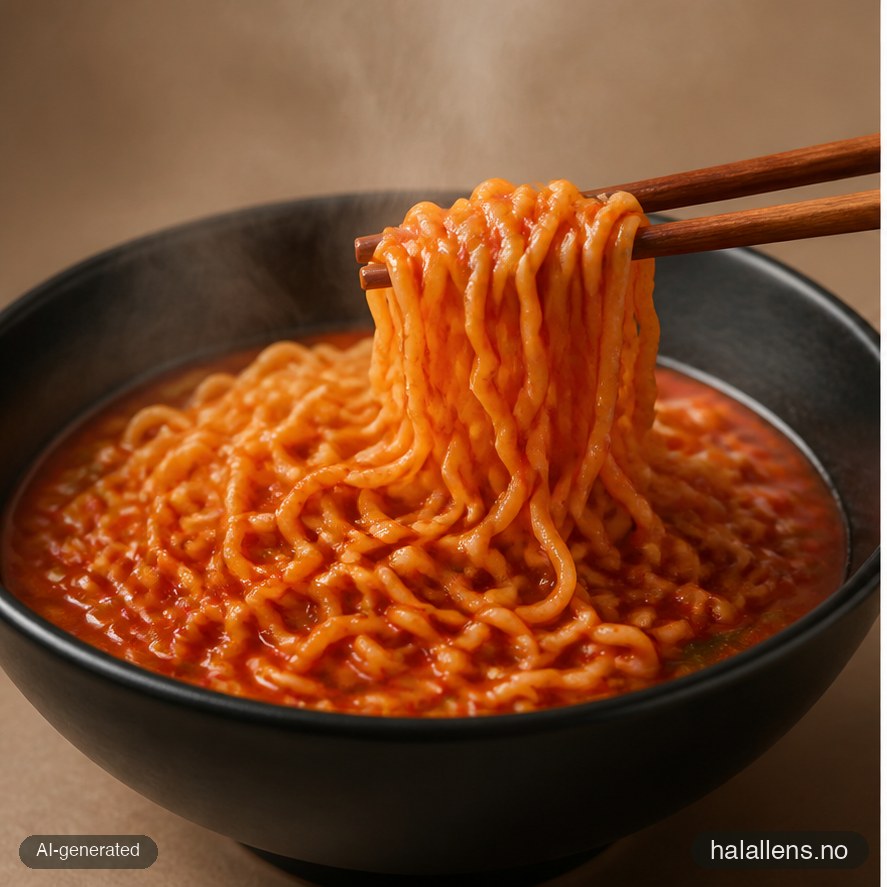
A red-and-black Buldak packet can look familiar in every shop, yet the halal answer depends on the version in your hand. Samyang Foods sells certified export packs alongside Korean-market products whose certification may not be shown. The logo, the market label and the flavour’s exact ingredient declaration matter more than the colour of the packet or the name “hot chicken”.
Quick answer: Samyang Buldak is HALAL when the exact export pack carries a valid KMF, MUI or applicable Indonesian halal mark. Samyang’s official pages identify Original, Cheese, Big Bowl, Stew and Curry Buldak formats as KMF Halal, while Korean-domestic packs need separate checking. The 2017 Indonesia incident involved specific unregistered imports, so verify the logo rather than generalizing from the brand name.
The certified export line: KMF and MUI
Samyang Foods’ own English product catalogue labels the Buldak Ramen Original as “KMF Halal certified”. The same catalogue identifies Buldak Ramen Cheese, Buldak Big Bowl, Buldak Ramen Stew type and Buldak Ramen Curry as KMF Halal or KMF Halal certified. KMF is the Korea Muslim Federation, the Korean certification body named on those product pages.
For Indonesia, Samyang’s official September 2017 press release says it received MUI certification for six products: Buldak Ramen, Big Bowl Buldak Ramen, Cup Buldak Ramen, Cheese Buldak Ramen, Big Bowl Cheese Buldak Ramen and Buldak Ramen Ice. Indonesia’s certification system has since moved to BPJPH, so an imported pack may show a current Indonesian mark or registration rather than the older MUI presentation. The exact packaging remains the decisive evidence.
A certified export line does not mean every Buldak flavour is certified everywhere. It means the particular product, recipe, factory or export presentation covered by the certification can be identified. A pack showing KMF, MUI, BPJPH or another recognized market certification can receive a HALAL verdict when it matches the product and the current label.
Malaysia and Indonesia are important import markets, but the presence of a halal logo on one shipment does not prove that every Korean-language pack in a store has the same status. Look for the logo on the physical packet, not only in an online listing. Retail photographs can show a different format, an old design or a product intended for another market.
The 2017 Indonesia history and what changed
In June 2017, Indonesia’s BPOM reported that testing of Korean instant noodles found different outcomes: some samples met the requirements, while others tested positive for porcine DNA. The public discussion included Samyang products, and MUI told Indonesian media that the specific Samyang U-Dong and Kimchi products named in the episode had not been registered for MUI halal certification. BPOM instructed action against products that did not meet the requirements.
The incident should be described precisely. It was not a finding that every Samyang product or every Buldak pack contained pork DNA. It showed that products sold under a familiar Korean brand could arrive through different import channels and have different certification status. The label and importer mattered.
Samyang’s own timeline records MUI certification for six Buldak products in September 2017, after the controversy, and KMF halal certification for Buldak and other products before that. The practical change for shoppers was clearer separation between certified export products and unverified Korean-market or parallel-import packs. A current halal logo is more useful than a general statement that Samyang noodles are halal.
The halal mark also matters because seasoning sources can be hidden behind technical names. A chicken-flavour powder may contain only flavour compounds, or it may include a meat-derived component. A certification audit is the evidence that the complete recipe and supply chain were reviewed for that product. If a pack does not show certification and contains an unspecified meat-derived seasoning, HalalLens classifies it as MUSHBOOH or HARAM depending on the wording and evidence.
Certified flavours versus Korean-domestic packs
The most reliable flavour list is the one Samyang itself marks. Original, Cheese, Big Bowl, Stew type and Curry have current official product pages that identify KMF Halal. The MUI announcement provides a separate historical Indonesian list: Original Buldak, Big Bowl, Cup, Cheese, Big Bowl Cheese and Buldak Ramen Ice. These records do not prove that every later flavour, limited edition or cup format is covered.
Carbonara, 2x Spicy, Jjajang, Quattro Cheese and Habanero Lime are widely sold in export channels, but a flavour name alone is not a certificate. For these products, use Check label unless the actual pack carries a current certification mark that can be matched to the market and recipe. This is especially important for Korean-domestic packaging, where Korean text may be prominent and an export halal logo may be absent.
A Korean-made product can still be exported as halal, and a Korean-language product can be sold abroad through a parallel importer without the certification information needed for a HALAL verdict. Country of manufacture is not the same as certification status. The physical mark and the exact ingredient panel settle the question.
Flavour-by-flavour table
This table uses current Samyang product pages, the company’s MUI announcement and the pack-first verification rule. HALAL means the named version is identified by an applicable certification mark. MUSHBOOH means the pack is not certified and the source of a meat-derived or technical seasoning cannot be resolved. Check label is used where a flavour may have an export version but the version in question is not confirmed by the available product record.
| Product or pack | Verdict | Deciding factor |
|---|---|---|
| Buldak Ramen Original export pack | HALAL | Samyang’s official product page identifies the product as KMF Halal certified; match the logo and format. |
| Buldak Ramen Cheese export pack | HALAL | Samyang’s official product page marks Buldak Ramen Cheese KMF Halal certified. |
| Buldak Big Bowl export pack | HALAL | Current Samyang catalogue identifies the bowl format as KMF Halal. |
| Buldak Stew type export pack | HALAL | Samyang’s official page describes the product as KMF Halal. |
| Buldak Curry export pack | HALAL | Samyang’s official page marks the Curry flavour KMF Halal. |
| Buldak Carbonara or 2x Spicy without a visible halal logo | Check label | Export versions may exist, but the flavour name alone does not establish current certification. |
| Jjajang, Quattro Cheese or Habanero Lime import pack | Check label | Confirm the applicable KMF, MUI, BPJPH or other recognized halal mark on the exact pack. |
| Korean-domestic Buldak pack | MUSHBOOH | Domestic packaging may not carry export certification and may use a different seasoning declaration. |
| Any pack listing pork, porcine extract or pork-derived seasoning | HARAM | The ingredient is explicitly prohibited under HalalLens’s verification rule. |
At the noodle shelf, scan the exact packet with the free HalalLens scanner to check the flavour enhancers and seasoning terms in seconds.
Seasoning ingredients decoded
The noodle cake is usually the easy part. The concern is the liquid sauce, powder sachet and dried garnish. Export ingredient panels can include chicken-flavour wording, soy sauce, yeast extract, milk or cheese ingredients, chilli seasonings and flavour enhancers. A meat-flavour name does not by itself prove that real meat is present, but an unspecified meat-derived seasoning also cannot be treated as verified halal without the certification mark.
E621 is monosodium glutamate. E627, disodium guanylate, and E631, disodium inosinate, are ribonucleotide flavour enhancers. Their possible sources can differ: fermentation, yeast, fish or animal material may be used depending on the supplier and specification. The number alone does not tell you which source was used. A halal certification audit is the reason these ingredients can be accepted in a certified export pack; on an uncertified domestic pack, the source question remains open. HalalLens’s E631 reference and E621 reference explain the difference between the additive name and its source.
Maltodextrin is a carbohydrate ingredient commonly used as a carrier or bulking agent in seasonings. It is not meat and does not turn a recipe haram by its name. Its presence still does not replace a halal mark when the same sachet contains flavourings or nucleotides whose origin is not disclosed. See the maltodextrin reference when a label uses it inside a seasoning blend.
Alcohol is a separate check. Samyang’s official halal announcement says the certified export products meet halal requirements, while certification controls the complete recipe. If a local pack lists alcohol, ethanol, cooking wine or an alcoholic extract, it needs a separate review and cannot receive HALAL simply because another Buldak pack does. The ethanol reference explains why the label wording matters.
Gelatin is not expected in the basic noodle cake, but recipes and garnish packets can change. HalalLens’s gelatin reference is useful when a local declaration includes it. Do not infer that every Buldak format is identical. Read all sachets, including flakes and powdered cheese, and scan the full ingredient panel.
How to spot the halal logo
Start with the front and side panels. A certified export pack should show a halal mark associated with the certification body and the relevant market. KMF is common on Samyang’s Korean export presentation. Indonesian packs may show the MUI legacy mark or a current BPJPH registration/mark, depending on the import date and transition. Malaysia-bound products may carry the certification information required for that market, but do not treat a retailer’s “halal” tag as a substitute for the packet.
Then check the language and importer details. Export packaging often includes English, Arabic or local-market information alongside Korean, while Korean-domestic packs may be entirely Korean and lack the halal mark. This is a clue, not proof. Some export packaging can still contain Korean text, and a parallel importer can sell a domestic pack outside Korea.
Match the logo to the flavour and format. Original packet, cup, Big Bowl and limited-edition versions are separate products. If the logo is cropped, printed only in an online photograph or absent from the physical pack, classify it as Check label or MUSHBOOH rather than assuming it is the certified export version. A product made by Samyang Foods is not automatically certified just because the company has halal-certified items.
The simplest shopping rule is: choose the exact Buldak pack with the valid halal logo, then confirm that the ingredient panel matches the product. If the source of a meat-derived seasoning is unspecified and no certification is shown, do not upgrade the verdict based on social-media lists or the flavour name.
Frequently asked questions
Is Samyang Buldak halal?
The certified export versions are halal when the exact pack carries an applicable KMF, MUI, BPJPH or other recognized halal mark. Samyang’s official pages identify several Buldak formats as KMF Halal. Korean-domestic and parallel-import packs need separate checking because the recipe and certification presentation may differ.
Which Buldak flavours are halal-certified?
Samyang’s current official pages identify Original, Cheese, Big Bowl, Stew type and Curry Buldak formats as KMF Halal. Samyang’s 2017 MUI announcement named Original, Big Bowl, Cup, Cheese, Big Bowl Cheese and Buldak Ramen Ice. Other flavours may have export versions, but the current packet must show the certification mark.
Is Korean-market Samyang halal?
A Korean-market Samyang or Buldak pack is not automatically halal-certified. If it lacks a valid halal logo and contains flavourings or meat-derived seasoning with unresolved sources, HalalLens classifies it as MUSHBOOH. Check the physical pack rather than relying on the fact that the noodles were made by Samyang Foods.
What happened with Samyang in 2017?
Indonesia’s BPOM reported that some imported Korean noodles tested positive for porcine DNA while other samples met requirements. The specific Samyang U-Dong and Kimchi products discussed by MUI had not been registered for MUI halal certification. Samyang later announced MUI certification for six named Buldak products, which is why the certification mark and importer details matter.
How do I spot the halal logo on Buldak?
Look on the physical packet for a KMF mark or the applicable Indonesian or other market certification mark, then match it to the flavour and format. Do not rely on a retailer photograph, a seller’s description or the red-and-black packaging. When the logo is absent or cannot be matched, scan the complete ingredient panel before buying.
This analysis was AI-assisted and reviewed against manufacturer statements and halal certification-body records. Last verified: August 2026.
Before you cook the noodles, scan the packet with the free HalalLens scanner for an ingredient-by-ingredient verdict based on the exact pack you purchased.