Halal Cinnamon Rolls — Soft Frosted Breakfast Rolls
Pillowy soft halal cinnamon rolls made with alcohol-free vanilla and halal-certified butter, topped with thick cream cheese frosting. Perfect for Eid morning or any halal breakfast.
Halal Cinnamon Rolls — Soft Frosted Breakfast Rolls
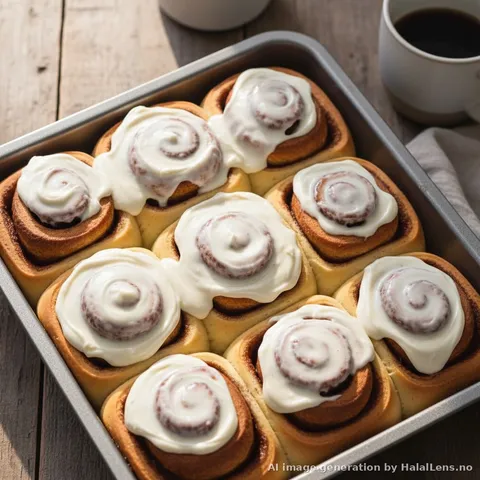
Wake up to the most pillowy, golden-brown halal cinnamon rolls you have ever tasted. Made entirely with halal-certified ingredients — including alcohol-free vanilla extract and halal-certified butter — these soft, swirled rolls are topped with a thick, tangy cream cheese frosting that melts into every layer. Whether you are baking for Eid morning, a family brunch, or just a cozy weekend treat, this is the halal cinnamon rolls recipe you will return to again and again.
What Makes Cinnamon Rolls Halal?
A classic cinnamon roll recipe can contain several ingredients that are problematic from a halal perspective. Before you bake, it is important to understand exactly what to look for on the label.
Vanilla Extract — The Most Common Issue
Standard vanilla extract contains 35% or more alcohol (ethanol), which makes it non-halal according to the majority of Islamic scholars. Fortunately, several excellent alternatives exist:
- Alcohol-free vanilla extract: Made using vegetable glycerin as the solvent instead of alcohol. Widely available at halal grocery stores and online. This is the ingredient used in our recipe — and it has been verified as HALAL in the HalalLens ingredient database.
- Vanilla bean paste: Contains the seeds of real vanilla beans in a sugar syrup base. Check for halal certification, as some brands may add alcohol.
- Vanilla powder: Dried and ground vanilla beans with no liquid base. Fully halal and excellent for baking.
Butter and Dairy Products
Butter itself is halal — it is made from cream, a natural dairy product. However, some issues can arise:
- Butter from animals not slaughtered according to halal standards may be considered questionable by some scholars, especially in regions where non-halal animal fats are common.
- Some brands of butter use natural flavors that may be derived from non-halal sources.
- For certainty, look for butter with a recognized halal certification mark, or use butter from a trusted halal supplier.
Cream Cheese
Cream cheese is a Mashbooh (doubtful) ingredient in some cases — rennet used in production may come from non-halal slaughtered animals. Always choose cream cheese that is either labeled halal-certified or uses microbial/vegetable rennet. Many grocery store own-brand cream cheeses use microbial rennet and are suitable.
Eggs
Eggs are halal in Islamic dietary law. No special halal certification is required for eggs in most scholarly opinions, as they are not a slaughtered animal product.
Yeast
Active dry yeast is halal. It is a microorganism, not an animal product. However, some flavored yeast products may contain additives — always check the label. Standard active dry yeast as used in this recipe is consistently rated HALAL by Islamic food authorities.
Why This Halal Cinnamon Roll Recipe Works
There are hundreds of cinnamon roll recipes online, but most are not designed with halal baking in mind. Here is what sets this recipe apart:
- Enriched yeast dough: Butter, eggs, and milk in the dough create a tender, brioche-like crumb that stays soft for days.
- Double rise method: Two rise periods (bulk fermentation + proofing in the pan) develop flavor and create an airy, light texture.
- Brown sugar + cinnamon + nutmeg filling: The addition of nutmeg adds subtle warmth and depth beyond plain cinnamon sugar.
- Cream cheese frosting applied warm: Applying frosting to warm rolls allows it to seep into the layers, creating gloriously gooey, melt-in-your-mouth rolls.
- 100% halal-certified ingredients: Every ingredient has been chosen with halal compliance in mind. No compromise on taste, no compromise on faith.
Ingredients
All ingredients listed below are halal-certified or have been verified as halal. Links go to the HalalLens ingredient database where you can see full halal status details.
For the Dough
- 4 cups (480g) all-purpose flour, plus extra for dusting — verified HALAL
- 2¼ tsp (7g / 1 packet) active dry yeast — verified HALAL
- 1 cup (240ml) whole milk, warmed to 110°F (43°C)
- ⅓ cup (67g) granulated white sugar
- ⅓ cup (75g) halal-certified unsalted butter, softened
- 2 large eggs, room temperature
- 1 tsp salt
- 1 tsp alcohol-free vanilla extract — verified HALAL
For the Cinnamon Filling
- ½ cup (115g) halal-certified unsalted butter, softened
- ¾ cup (150g) light brown sugar, packed — verified HALAL
- 2½ tbsp ground cinnamon
- ¼ tsp ground nutmeg — verified HALAL
For the Cream Cheese Frosting
- 4 oz (115g) halal-certified cream cheese, softened (look for vegetable/microbial rennet)
- ¼ cup (57g) halal-certified unsalted butter, softened
- 1½ cups (180g) powdered sugar, sifted
- 3–4 tbsp whole milk
- 1 tsp alcohol-free vanilla extract
Step-by-Step Instructions
Total time: approximately 2 hours 30 minutes (including rise time). Active time: 45 minutes.
Step 1: Activate the Yeast
In a small bowl, combine warm milk (110°F / 43°C — warm to the touch but not hot), 1 teaspoon of sugar, and the active dry yeast. Stir gently and set aside for 5–10 minutes. The mixture should become foamy and fragrant, indicating the yeast is alive and active. If nothing happens after 10 minutes, your yeast may be expired or your milk was too hot — start over with fresh yeast.
Step 2: Make the Dough
In the bowl of a stand mixer fitted with the dough hook, whisk together the flour, remaining sugar, and salt. Create a well in the center and add the foamy yeast mixture, the softened butter (cut into small pieces), eggs, and alcohol-free vanilla extract.
Mix on low speed for 2 minutes to bring everything together. Increase to medium speed and knead for 8–10 minutes until the dough is smooth, silky, and slightly tacky (not sticky). It should pull cleanly from the sides of the bowl. If kneading by hand, work the dough on a lightly floured surface for about 12–15 minutes.
Test: the dough is ready when you can stretch a small piece between your fingers and it becomes translucent (the "windowpane test") without tearing.
Step 3: First Rise (Bulk Fermentation)
Shape the dough into a smooth ball. Place it in a large bowl that has been lightly oiled. Turn the dough once to coat it in oil, then cover with plastic wrap or a damp kitchen towel. Let rise in a warm, draft-free spot for 1 to 1.5 hours, until doubled in size.
Warm oven trick: Turn your oven to the lowest setting for 2 minutes, then turn it off. Place the covered bowl inside. The residual warmth creates an ideal proofing environment.
Step 4: Prepare the Cinnamon Filling
While the dough rises, stir together the softened halal butter, brown sugar, ground cinnamon, and nutmeg until a smooth, spreadable paste forms. If it is too thick, microwave for 5 seconds. Set aside at room temperature so it stays spreadable.
Step 5: Roll, Fill, and Shape
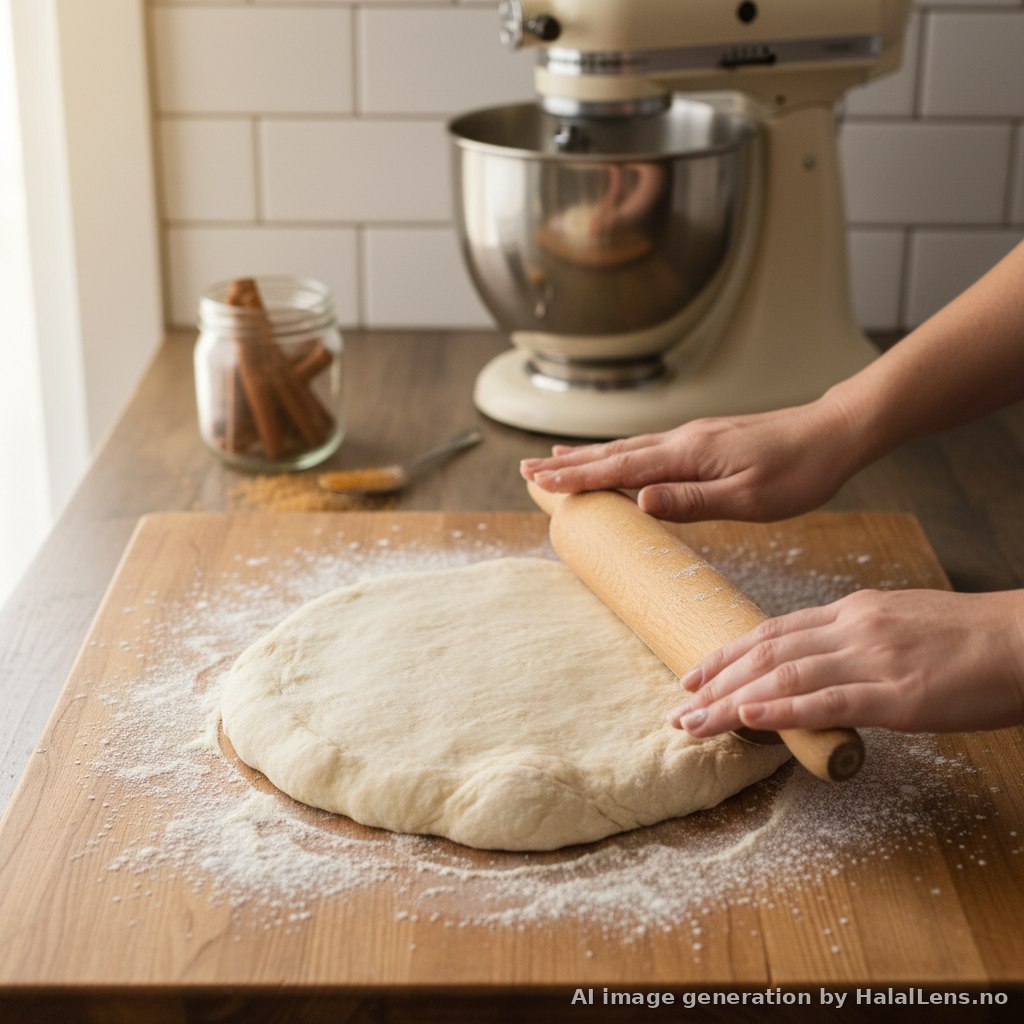
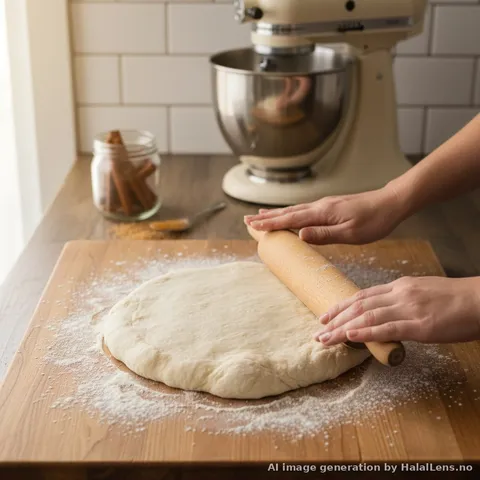
Once the dough has doubled, punch it down to release the air. Turn it out onto a lightly floured surface and roll into a rectangle approximately 18×12 inches (45×30 cm). The dough should be about ¼ inch (6mm) thick.
Spread the cinnamon filling evenly across the entire surface, leaving a ½-inch border along the far long edge (this makes rolling easier). Starting from the long edge closest to you, roll the dough firmly into a tight log. Pinch the seam tightly to seal.
Step 6: Slice the Rolls
For perfectly even, clean-cut rolls, use unflavored dental floss: slide a piece under the log, cross the ends over the top, and pull tight. This avoids crushing the rolls. Alternatively, use a sharp serrated knife with a sawing motion.
Cut the log into 12 equal pieces (approximately 1.5 inches / 4 cm each). Arrange them cut-side up in a well-greased 9×13 inch (23×33 cm) baking dish. Leave a little space between each roll.
Step 7: Second Rise (Proofing)
Cover the baking dish loosely with plastic wrap and let the rolls proof for 30–45 minutes, until they are puffy, nearly touching, and have risen visibly. While they proof, preheat your oven to 350°F (175°C).
Step 8: Bake
Bake in the preheated oven for 22–26 minutes. The rolls should be golden brown on top and reach an internal temperature of 190°F (88°C). Do not overbake — slightly underdone rolls will be softer as they cool, and the frosting adds moisture. A toothpick inserted in the center of a roll should come out clean.
Step 9: Make the Cream Cheese Frosting
While the rolls bake, prepare the frosting. Using a hand mixer or stand mixer, beat the halal cream cheese and halal butter together until completely smooth and fluffy, about 2 minutes. Add the sifted powdered sugar and mix on low until combined, then increase to medium-high for 1–2 minutes. Add milk one tablespoon at a time until the frosting is thick but spreadable. Stir in the alcohol-free vanilla extract.
Step 10: Frost and Serve
Remove the rolls from the oven and let them cool for 5–10 minutes (they should still be warm, not piping hot). Spread the cream cheese frosting generously over the top. The warmth will melt the frosting slightly, allowing it to drip into the swirls and create those legendary gooey layers. Serve immediately and watch them disappear.
Process Photos
Tips for the Softest, Fluffiest Halal Cinnamon Rolls
After many rounds of testing, here are the techniques that make the biggest difference:
Use Room-Temperature Ingredients
Cold butter and cold eggs slow yeast activity and create an uneven dough texture. Take your butter, eggs, and cream cheese out of the refrigerator at least 1 hour before baking.
Do Not Over-Flour the Dough
Adding too much flour is the number-one cause of dense, dry cinnamon rolls. The dough should be slightly tacky — resist the urge to add extra flour. If it is sticking excessively, add only 1 tablespoon at a time.
Check Your Milk Temperature
Milk that is too hot (above 120°F / 49°C) will kill the yeast. Too cold (below 100°F / 38°C) will fail to activate it. Use a kitchen thermometer for accuracy, or test it on the inside of your wrist — it should feel pleasantly warm, like bath water.
Do Not Skip the Second Rise
The second proof (after slicing) is what gives the rolls their airy, pillowy texture. Rolls that skip this step will be dense and bread-like rather than light and fluffy.
Apply Frosting While Warm
Frosting applied to completely cool rolls just sits on top. Frosting on warm rolls melts into all the layers and crevices, creating that luxurious, gooey quality that makes cinnamon rolls truly special.
The Dental Floss Method
When slicing your roll log, a serrated knife pushes the filling outward and crushes the rolls slightly. Dental floss (unflavored) slices cleanly with no compression, preserving the beautiful swirl pattern.
Halal Ingredient Substitutions
Need to adapt this halal cinnamon rolls recipe for dietary needs or availability? Here are the best tested substitutions:
Dairy-Free Halal Cinnamon Rolls
- Butter: Use halal-certified coconut oil (refined, for neutral flavor) or a halal vegan butter stick (such as those made from palm or coconut oil). Avoid margarines that list "natural flavors" without halal certification.
- Milk: Unsweetened oat milk or full-fat coconut milk work best — they have enough fat content to enrich the dough. Almond milk produces slightly less tender results.
- Cream Cheese Frosting: Use halal-certified cashew cream cheese or a coconut cream-based frosting (blend coconut cream with powdered sugar and vanilla).
Egg-Free Version
Replace each egg with a flax egg (1 tablespoon ground flaxseed + 3 tablespoons water, rested for 5 minutes). The rolls will be slightly less rich but still tender and delicious.
Vanilla Alternatives
- Vanilla bean paste (halal-certified): 1:1 swap for alcohol-free extract. Adds beautiful specks of vanilla bean.
- Vanilla powder: Use ¾ tsp per tsp of extract called for.
- Omit entirely: The cinnamon flavor is dominant enough that vanilla is optional.
Flour Options
Bread flour (higher gluten content) can be substituted for all-purpose flour for chewier, more pull-apart rolls. Use a 50/50 blend of bread flour and all-purpose for the best of both worlds.
Storage and Make-Ahead Instructions
Storing Baked Rolls
Store cooled cinnamon rolls in an airtight container at room temperature for up to 2 days. For longer storage, refrigerate for up to 5 days. Reheat individual rolls in the microwave for 20–30 seconds to restore softness.
Freezing Baked Rolls
Freeze unfrosted baked rolls in an airtight container or zip-lock bags for up to 3 months. Thaw overnight at room temperature, then warm in a 300°F (150°C) oven for 10 minutes. Frost just before serving.
Overnight Make-Ahead Method
This is ideal for serving fresh rolls at Eid breakfast or a morning gathering:
- Complete all steps through slicing and arranging rolls in the baking dish.
- Cover tightly with plastic wrap and refrigerate overnight (up to 15 hours).
- The next morning, remove from the refrigerator and let stand at room temperature for 45–60 minutes while you preheat the oven.
- Bake as directed and frost just before serving.
Freezing Unbaked Rolls
After slicing, place rolls on a parchment-lined baking sheet and freeze until solid (about 2 hours). Transfer to a freezer bag. When ready to bake, place frozen rolls in a greased baking dish, cover, and thaw/proof overnight in the refrigerator. Proceed with the second rise and baking as normal.
Frequently Asked Questions
Is vanilla extract halal?
Standard vanilla extract contains 35% or more alcohol (ethanol) and is considered haram by most Islamic scholars. Always use alcohol-free vanilla extract or vanilla powder in your halal baking. Alcohol-free vanilla extract uses vegetable glycerin as a base and is widely available in halal grocery stores and online.
Is butter halal?
Plain, pure butter made from cow's milk is generally considered halal, as it is a dairy product derived from a halal source. However, some Islamic scholars recommend seeking halal-certified butter to ensure no cross-contamination with non-halal animal fats, especially in mixed-use processing facilities. Look for butter with an IFANCA, MUI, JAKIM, or equivalent certification for full certainty.
Is cream cheese halal?
Cream cheese can be Mashbooh (doubtful) depending on the type of rennet used in production. Traditional animal rennet from non-halal slaughtered animals makes it non-halal. Choose cream cheese labeled as using vegetable or microbial rennet, or look for halal-certified brands. Many supermarket own-brand cream cheeses use microbial rennet — check the label.
Can I make these cinnamon rolls without a stand mixer?
Yes. Mix the ingredients by hand in a large bowl until a rough dough forms, then turn out onto a floured surface and knead by hand for 12–15 minutes until smooth and elastic. The process is more physical but the result is equally delicious.
Why did my cinnamon rolls not rise?
The most common cause is dead or expired yeast. Always check the expiry date and proof your yeast before starting — it should foam in warm milk within 10 minutes. Other causes include milk that was too hot (killed the yeast), a kitchen that is too cold (slow rise — just give it more time), or too much salt in direct contact with the yeast before mixing.
Can I use instant yeast instead of active dry yeast?
Yes. Use the same amount of instant yeast (2¼ tsp). Instant yeast does not need to be proofed in warm milk first — simply add it directly to the dry ingredients. You may find the dough rises slightly faster.
My rolls are doughy in the middle — what went wrong?
This usually means they were underbaked. The internal temperature should reach 190°F (88°C). If the tops are browning too quickly but the center is still raw, tent the pan loosely with aluminum foil and continue baking. Every oven runs differently — use a thermometer for reliability.
Are these halal cinnamon rolls suitable for Eid?
Absolutely. These rolls are a wonderful choice for Eid al-Fitr and Eid al-Adha celebrations. The overnight make-ahead method (see Storage section above) is especially practical for Eid mornings — prepare everything the night before and bake fresh in time for family breakfast after Eid prayer.
Nutrition Information
Per serving (1 frosted roll, based on 12 rolls). Values are estimates.
| Nutrient | Amount |
|---|---|
| Calories | 385 kcal |
| Total Carbohydrate | 58g |
| Total Fat | 14g |
| Saturated Fat | 8g |
| Protein | 6g |
| Sugar | 28g |
| Fiber | 2g |
| Sodium | 220mg |
Verify Your Ingredients with HalalLens
Before you bake, make sure every ingredient is halal-certified. Use the HalalLens app to scan product barcodes or ingredient labels instantly — our database covers hundreds of thousands of food products worldwide. Bake with confidence and share the joy with family and friends.