Halal Hainanese Chicken Rice — Singapore's National Dish Made Halal
Singapore's unofficial national dish: tender poached halal chicken with fragrant rice cooked in chicken fat, three dipping sauces, and UNESCO-recognised hawker heritage. Full step-by-step halal recipe.
Halal Hainanese Chicken Rice — Singapore’s Soul on a Plate

In a city defined by culinary ambition and astonishing variety, one dish stands above all others as Singapore’s unofficial national dish: Hainanese chicken rice. Deceptively simple in description — poached chicken, rice cooked in chicken broth and fat, a trio of dipping sauces — it is a dish of extraordinary nuance that has been refined across generations of hawkers into something approaching perfection.
For Muslim diners navigating Singapore’s extraordinary food scene, the question of where to find halal Hainanese chicken rice is an important one. The dish originated with Hainanese Chinese immigrants in the early 20th century, and traditional stalls are not always halal-certified. But Singapore’s Muslim community is large and food-proud, and today dozens of certified halal stalls serve exceptional versions — from the famous Tian Tian at Maxwell Food Centre (which has obtained halal certification) to dedicated halal hawker stalls across the island.
This recipe gives you the full technique so you can make a completely halal-verified version at home: the poaching method for impossibly tender, silky-skinned chicken; the fragrant rice cooked in chicken fat and pandan-infused broth; the three essential sauces. Every ingredient has been cross-referenced with the HalalLens ingredient database for halal compliance.
The Story of Hainanese Chicken Rice: From Hainan to UNESCO
The origins of the dish trace to Wenchang chicken (Wenchang ji), a beloved preparation from Wenchang County on China’s Hainan Island. Hainanese migrants who arrived in British Malaya and Singapore in the late 19th and early 20th centuries brought their culinary traditions with them, adapting their home recipes to local ingredients and tastes.
The defining innovation of the Singaporean version is the rice. Rather than plain steamed rice, each grain is toasted in rendered chicken fat with garlic and ginger, then cooked in the poaching broth alongside pandan leaves. The result is oily rice (you fan in Hokkien Chinese) that is intensely fragrant, slightly glossy, and utterly addictive. The rice, many argue, is the true star of the dish — the chicken merely the occasion for it.
Singapore’s hawker culture — the network of open-air food stalls and centres that has fed the city-state for over a century — was inscribed on UNESCO’s Representative List of the Intangible Cultural Heritage of Humanity in 2020. Hainanese chicken rice is among the most emblematic dishes of this living cultural tradition. At hawker centres like Maxwell Food Centre, Chinatown Complex, and Toa Payoh, chicken rice stalls open before dawn and sell out before noon. The best hawkers spend decades perfecting their craft.
In Malaysia, a parallel version developed — nasi ayam — with slightly different sauces and a darker, more gingery chili sauce. Both versions are beloved across Southeast Asia, with variations found in Thailand (khao man gai), Vietnam, and Cambodia. All trace their lineage to those original Hainanese migrants who remade a dish from home into something that would become a national obsession.
Halal Verification: Is Hainanese Chicken Rice Halal?
Traditional Hainanese chicken rice stalls in Singapore are predominantly run by Chinese families and are not always halal-certified. The chicken may not be halal-slaughtered, and the rice may be cooked alongside pork lard in some older recipes. For Muslim diners, it is essential to verify certification before eating at a stall.
The good news: Singapore’s Muslim community has driven demand for halal versions, and today there are many excellent certified halal options. The Majlis Ugama Islam Singapura (MUIS) maintains a certification registry. When cooking at home, achieving a fully halal version is straightforward — every ingredient in this recipe is either inherently halal or available in halal-certified form.
Key halal considerations for this recipe:
- Chicken: Must be halal-slaughtered (zabihah). Look for halal certification on packaging or buy from a certified halal butcher.
- Dark soy sauce: Most commercial dark soy sauces are halal, but check for alcohol-containing additives. We recommend verified halal brands such as Habhal’s or Lee Kum Kee Halal.
- Rice: Plain jasmine rice is inherently halal.
- Chili sauce: Bottled chili sauce should be checked for alcohol-based preservatives. Homemade chili sauce (see recipe below) is fully halal-safe.
- Sesame oil: Pure sesame oil is halal.
HalalLens Status: All ingredients in this recipe verified as HALAL when sourced from certified suppliers. Use the HalalLens scanner to verify any packaged ingredient before use.
Ingredients for Halal Hainanese Chicken Rice
Serves 4. Preparation time: 20 minutes. Cooking time: 60 minutes.
For the Poached Chicken
- 1 whole halal chicken (about 1.5 kg / 3.3 lbs), rinsed
- 1 thumb-sized piece fresh ginger, thinly sliced
- 3 stalks spring onions (scallions), tied in a knot
- 2 stalks lemongrass, bruised
- 3 pandan leaves, knotted
- 2 tsp sesame oil
- 1 tsp sea salt
- 1/2 tsp white pepper
For the Fragrant Chicken Rice
- 2 cups jasmine rice, washed and drained
- 3 tbsp rendered chicken fat (skimmed from broth) or neutral oil
- 4 cloves garlic, minced
- 1 tsp fresh ginger, grated
- 2 shallots, finely sliced
- 2 stalks pandan leaves, knotted
- 2.5 cups reserved chicken broth
- 1/2 tsp salt
For Serving
- 1 cucumber, sliced
- 3 tbsp dark soy sauce (halal-certified), mixed with 1 tsp sesame oil
- Ginger-scallion oil (1/4 cup ginger + spring onion + hot oil)
- Halal chili sauce (see below)
- Clear chicken broth, seasoned to taste
For the Halal Chili Sauce
- 6 red chillies, deseeded
- 3 cloves garlic
- 1 tsp fresh ginger
- 2 tbsp lime juice
- 1 tbsp sugar
- Salt to taste
How to Make Halal Hainanese Chicken Rice: Step-by-Step
Step 1: Prepare and Blanch the Chicken
Remove any giblets from the halal chicken and trim excess fat, reserving the fat. Rub the chicken inside and out with 1 teaspoon of salt. Bring a large pot of water to a rolling boil, then blanch the chicken for exactly one minute. Discard this water — the blanch removes impurities and gives the skin its final clarity. Rinse the chicken under cold water.
Step 2: Poach the Chicken Low and Slow
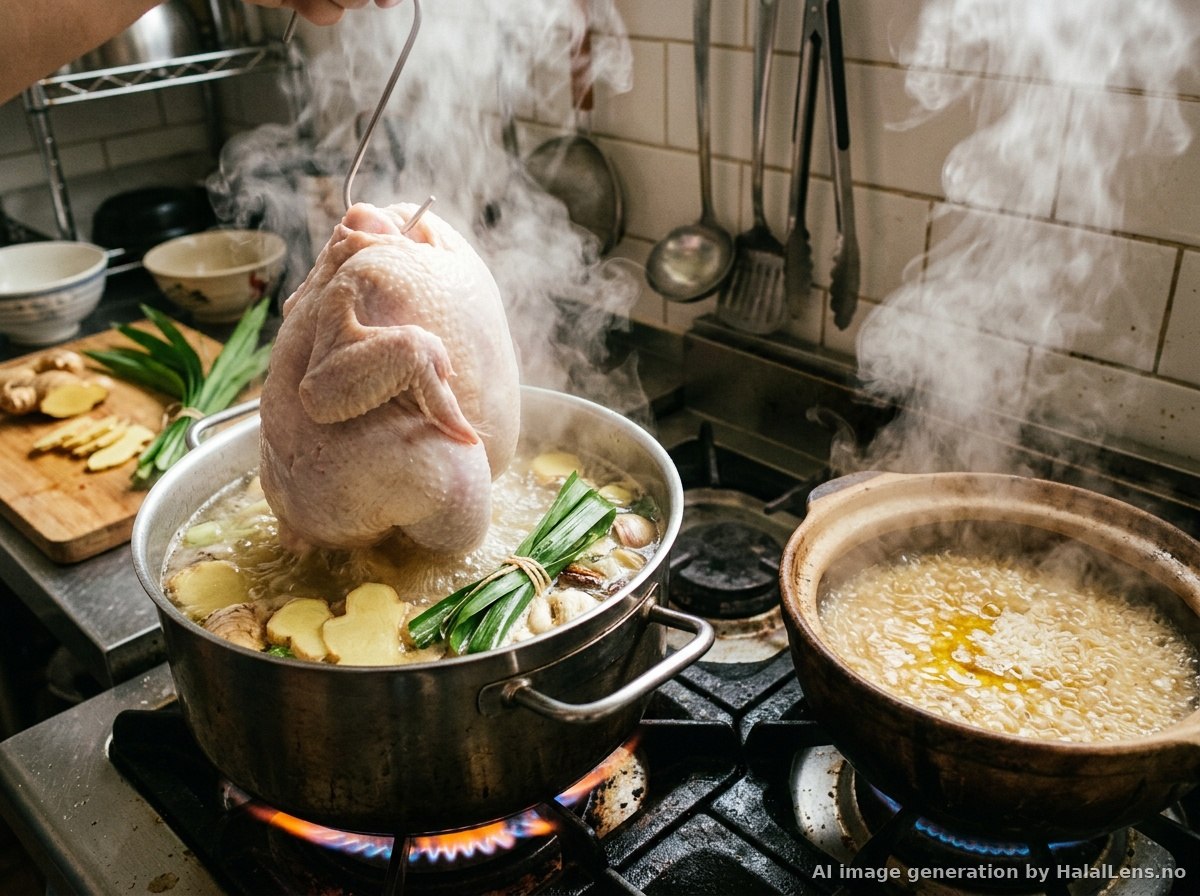
Fill the pot with fresh water, enough to fully submerge the chicken. Add the sliced ginger, knotted spring onions, lemongrass, and pandan leaves. Bring to a boil, then reduce heat to the lowest possible simmer — you want the water at about 80–85°C (176–185°F), with only occasional small bubbles. Gently lower the chicken in breast-side down. Cover and poach for 45–50 minutes, depending on size.
The low-temperature poach is the secret to Hainanese chicken’s signature texture: the breast meat stays impossibly moist, and the skin — rather than becoming rubbery — turns silky and almost translucent. The fat just beneath the skin stays in the skin rather than rendering out.
Doneness test: Pierce the thickest part of the thigh with a skewer. Juices should run clear and the internal temperature should reach 75°C (165°F).
Step 3: Ice Bath for Silky Skin
Remove the chicken from the broth and immediately plunge it into a large bowl of ice water. Leave for 10–15 minutes. This rapid cooling contracts the skin, giving it the distinctive firm-yet-silky texture that defines great Hainanese chicken. While the chicken cools, skim the chicken fat from the surface of the broth and reserve it for the rice. Season the broth with salt.
Step 4: Cook the Fragrant Rice
Heat the reserved chicken fat in a wok or heavy pan over medium heat. Add the sliced shallots, minced garlic, and grated ginger. Stir-fry for 2–3 minutes until fragrant and the shallots are softened but not coloured. Add the washed and drained jasmine rice, tossing to coat each grain in the fragrant fat. Cook for 2 minutes, stirring constantly.
Transfer the coated rice to a rice cooker or a medium pot. Add the reserved chicken broth in a 1:1.5 ratio (2 cups rice to 3 cups broth). Add the knotted pandan leaves and half a teaspoon of salt. Cook until the rice is done and all the broth has been absorbed. The cooked rice should be glossy, fragrant, and slightly oily — each grain perfectly separate.
Step 5: Prepare the Three Dipping Sauces
Chili sauce: Blend red chillies, garlic, ginger, lime juice, sugar, and salt into a smooth sauce. Adjust heat and acidity to taste. This bright, tangy, garlicky sauce is essential — it wakes up the gentle richness of the chicken.
Dark soy dip: Mix 3 tablespoons of halal-certified dark soy sauce with 1 teaspoon sesame oil and 1 teaspoon sugar. Stir until the sugar dissolves. This salty-sweet-umami sauce is drizzled directly over the sliced chicken at the table.
Ginger-scallion oil: Finely mince equal parts fresh ginger and spring onions. Season with salt. Heat neutral oil in a small pan until smoking, then pour directly over the ginger and scallion mixture — it will sizzle dramatically. The result is an intensely aromatic condiment that ties the whole dish together.
Step 6: Plate and Serve
Remove the chicken from the ice bath and pat dry. Rub the skin with sesame oil and a pinch of white pepper for sheen and aroma. Chop the chicken using a cleaver into pieces, or slice it thinly depending on preference. Hawker tradition calls for a full cleaver chop through the bone, which exposes the marrow and releases additional flavour.
Arrange the chicken pieces on a platter with cucumber slices. Press the fragrant rice into a small bowl or cup to form domes on each plate. Serve with all three dipping sauces, a small bowl of the clear seasoned chicken broth on the side, and a drizzle of dark soy over the chicken.
Chef’s Tips for the Best Halal Hainanese Chicken Rice
The Temperature Secret
The single most important factor in great Hainanese chicken is the poaching temperature. The water must never boil during the cooking time. A rolling boil will tighten the protein too quickly and result in dry, rubbery meat. Use a thermometer if you have one. The ideal range is 80–85°C. At this temperature, the chicken will be perfectly cooked in 45–50 minutes.
Using a Whole Bird vs. Bone-In Pieces
A whole bird is strongly preferred. The carcass and bones contribute enormous flavour to the poaching broth, which then becomes the cooking liquid for the rice. Bone-in chicken thighs can be substituted for a quicker version (25–30 minutes), but the rice will be less complex.
Pandan Leaves: Non-Negotiable
Pandan leaves (screwpine leaves) give the rice its distinctive South-East Asian fragrance — a grassy, slightly vanilla-adjacent aroma that is irreplaceable. They are widely available fresh or frozen in Asian supermarkets. Do not substitute pandan extract, which can be overpowering.
Sourcing Halal Chicken
Choose the best halal chicken you can find. Free-range or kampung (village) chickens, if available, will be noticeably more flavourful due to their firmer, less watery meat. However, any good-quality halal chicken will produce excellent results.
Make-Ahead Notes
The rice can be cooked up to 2 hours in advance and kept warm. The dipping sauces keep for 3–5 days refrigerated. The chicken is best served on the day of poaching but can be stored overnight in the fridge, loosely wrapped so the skin does not become soggy.
Where to Find Halal Chicken Rice in Singapore
Singapore’s hawker centre culture is one of the city’s great equalizers: presidents and construction workers eat at the same plastic tables, united by the same extraordinary food. For Muslim visitors and residents, finding halal chicken rice is easier than ever, with several notable options:
- Five Star Hainanese Chicken Rice — A well-known halal chain with multiple outlets across Singapore, serving both steamed and roasted versions.
- Boon Lay Power Nasi Lemak — While primarily known for nasi lemak, their chicken rice is a local secret worth seeking out.
- Wee Nam Kee Chicken Rice — Long-established and halal-certified.
- Various hawker stalls — Many individual hawker centre stalls across Singapore hold MUIS halal certification; look for the official crescent-and-star certificate displayed at the stall.
When visiting, always verify the current halal certification status, as certifications can lapse and stalls change ownership. The MUIS online certification portal allows you to check status by establishment name or location.
Nutrition Information
Per serving (1 plate, approximately 520 calories):
- Calories: ~520 kcal
- Protein: ~38g (from chicken)
- Carbohydrates: ~55g (from rice)
- Fat: ~14g (chicken fat in rice + sesame oil)
- Sodium: ~650mg (adjust soy sauce to preference)
Hainanese chicken rice is a nutritionally balanced meal: high in protein, with moderate carbohydrates from plain rice and minimal added fats beyond the chicken’s own. The broth is low-calorie and hydrating. The chili sauce adds capsaicin, which has documented metabolic benefits.
Frequently Asked Questions
Is Hainanese chicken rice always halal?
No. Traditional Hainanese chicken rice stalls in Singapore and Malaysia are predominantly run by Chinese families and are not always halal-certified. Some older recipes use pork lard in the rice. For Muslim diners, always verify the halal certification of a stall before eating. At home, following this recipe with halal-sourced chicken and certified soy sauce ensures full halal compliance.
Can I use chicken thighs instead of a whole chicken?
Yes, but the result will be noticeably different. A whole bird produces a more flavourful broth for the rice. If using thighs, supplement the poaching liquid with a quality halal chicken stock. Bone-in thighs will be ready in 25–30 minutes at the low-simmer temperature.
What is the difference between Hainanese chicken rice and nasi ayam?
Both are regional descendants of the original Wenchang chicken preparation. Singapore’s version typically features a lighter chili sauce and a ginger-scallion oil condiment. The Malaysian nasi ayam often includes a darker, more gingery chili sauce and may incorporate both steamed and roasted chicken options at the same stall. The rice preparation is nearly identical.
Can I substitute sesame oil?
Sesame oil is difficult to substitute — its toasty, nutty aroma is a defining characteristic of the dish. In a pinch, a very small amount of toasted sesame seeds can provide some of the flavour profile, but the oil is strongly recommended. All major brands of pure sesame oil are halal.
How long does it take to make Hainanese chicken rice?
Allow about 80 minutes total: 20 minutes of preparation and 60 minutes of mostly hands-off cooking (45–50 minutes poaching time). The dipping sauces can be made while the chicken poaches. This dish is ideal for a relaxed weekend cook.
The images in this post were generated with AI assistance (fal.ai Nano Banana 2) to illustrate the dish. Recipe content and ingredient verification are produced by HalalLens editors and verified against the HalalLens ingredient database.